

 by
by Pancreatic cancer is considered one of the most aggressive and deadliest forms of cancer worldwide. Despite decades of research, survival rates remain low, and treatment options are limited. Recently, the phrase “pancreatic cancer breakthrough” started trending globally after reports that a new experimental therapy successfully eliminated pancreatic tumors in mice.
This development has created strong interest among researchers, doctors, patients, and the pharmaceutical industry. Many headlines described it as a possible “cure,” but the reality is more complex. This article explains the discovery in detail, how the therapy works, what it really means for patients, and how it may shape the future of pharma and biotech careers.
Why Pancreatic Cancer is a Global Health Challenge
Pancreatic cancer develops in the pancreas, an organ responsible for digestion and blood sugar control. It is especially dangerous because symptoms usually appear at a late stage.
Key reasons why pancreatic cancer is difficult to treat include:
- Late diagnosis due to vague early symptoms
- Rapid tumor growth and early spread
- High resistance to chemotherapy and radiation
- Limited response to targeted therapies
According to global cancer data, pancreatic cancer has one of the lowest five-year survival rates among major cancers. This is why even early research success draws worldwide attention.

Why has Recent Pancreatic Cancer Research Drawn Global Attention?
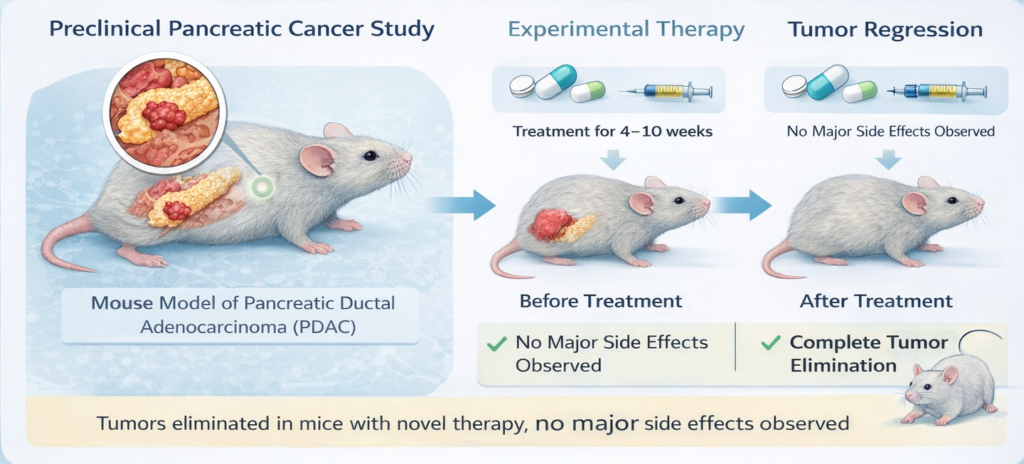
Recent interest in pancreatic cancer research has increased following the publication of a preclinical study from Spain reporting complete tumor elimination in animal models. The study was conducted by a research team led by Dr. Mariano Barbacid at the Spanish National Cancer Research Centre (CNIO) and focused on pancreatic ductal adenocarcinoma, the most aggressive and common form of pancreatic cancer.
The findings were published in a peer-reviewed scientific journal and demonstrated that a novel experimental therapy was able to suppress tumor growth and prevent resistance development in mouse models, without causing major observable toxicity. Such results are notable because pancreatic cancer is widely recognized for its poor response to existing treatments and rapid development of drug resistance.
Several factors have contributed to increased scientific and public interest in this study:
- The highly aggressive nature and low survival rate associated with pancreatic cancer
- The limited effectiveness of current therapeutic options
- Evidence of complete tumor elimination in preclinical models
- The absence of significant treatment-related side effects in animal studies
- The potential, though unconfirmed, relevance of these findings for future human clinical trials
As a result, this study has been widely discussed within the oncology research community and has renewed focus on the development of innovative therapeutic strategies for pancreatic cancer.
Overview of the New Pancreatic Cancer Study
The study was conducted by a research team that focused on overcoming treatment resistance in pancreatic cancer. Instead of using a single-target approach, the scientists tested a therapy designed to disrupt multiple survival pathways used by cancer cells.
Key findings from the study:
- Pancreatic tumors were eliminated in mouse models
- Tumor growth was strongly suppressed
- Treated mice showed minimal toxicity
- Cancer resistance mechanisms were reduced
These results suggest a strong therapeutic effect at the preclinical level.
Why Mice Are Used in Cancer Research
Animal models, especially mice, are commonly used in cancer research before testing therapies in humans. This is because:
- Mice share many biological similarities with humans
- Tumor behavior can be studied safely
- Drug effects and toxicity can be monitored
- Early safety data can be collected
However, success in mice does not guarantee success in humans. Many treatments fail during clinical trials even after promising animal results.
How does this New Therapy Work?
Pancreatic cancer cells survive by activating multiple defense mechanisms. Traditional treatments often fail because they target only one pathway.
This new therapy works by:
- Blocking tumor survival signals
- Disrupting resistance mechanisms
- Preventing cancer cells from adapting to treatment
- Making tumors more vulnerable to destruction
By targeting several processes at once, the therapy reduces the cancer’s ability to recover and spread.
Tumor Resistance: A Major Problem in Pancreatic Cancer
One of the biggest challenges in pancreatic cancer treatment is tumor resistance. Cancer cells change their structure and behavior to survive therapy.
Common resistance mechanisms include:
- Altered drug metabolism
- Protective tumor environment
- Genetic mutations
- Immune system suppression
The experimental therapy addresses these problems by interfering with multiple resistance pathways, which may explain its effectiveness in mice.
Is this a Cure for Pancreatic Cancer?
No.
It is important to clearly state that this is not a confirmed cure for pancreatic cancer in humans.
Reasons why caution is necessary:
- Results are from animal studies only
- Human biology is more complex
- Long-term safety is unknown
- Clinical effectiveness is unproven
The correct interpretation is that this is a promising research breakthrough, not a guaranteed cure.
Difference Between Cure, Remission, and Tumor Elimination
Understanding these terms helps avoid confusion:
- Tumor elimination: Tumors disappear during treatment
- Remission: Cancer signs reduce or disappear temporarily
- Cure: Cancer does not return over long-term follow-up
The current study demonstrated tumor elimination in mice, not a proven cure in humans.
What Happens Next: Human Clinical Trials Explained
Before patients can access this therapy, it must go through multiple stages of testing.
Phase 1 Trials
- Focus on safety
- Small group of volunteers
- Determine safe dosage
Phase 2 Trials
- Test effectiveness
- Monitor side effects
- Compare responses
Phase 3 Trials
- Large patient groups
- Compare with standard treatments
- Confirm benefit and safety
Only after successful trials can regulatory approval be considered.
How Long Do Clinical Trials Take?
Cancer drug development is a long process. Even with strong early data, it usually takes:
- 1–2 years for early trials
- 3–5 years for advanced trials
- Additional time for regulatory review
This means patients should not expect immediate availability.
Why Many Cancer Drugs Fail in Human Trials
Despite promising animal results, many therapies fail due to:
- Unexpected toxicity
- Limited effectiveness
- Poor drug absorption
- Differences between animal and human tumors
This is why scientific caution is essential.
Impact on Pancreatic Cancer Treatment Research
Even if the therapy does not reach clinical use, the research is still valuable. It:
- Improves understanding of tumor resistance
- Guides future drug design
- Encourages combination therapy development
- Opens new research directions
Each breakthrough builds knowledge that helps future therapies succeed.
What This Means for Patients and Families
For patients and caregivers, this research represents hope, not certainty. It highlights progress in understanding pancreatic cancer biology but does not replace existing treatments.
Patients should:
- Follow medical advice
- Avoid unverified treatments
- Stay informed through reliable sources
Importance of Responsible Health Reporting
Health news spreads fast, especially on social media. Overstated claims can:
- Create false hope
- Increase emotional stress
- Damage trust in science
Responsible reporting focuses on facts, limitations, and realistic timelines.
Role of the Pharmaceutical Industry
This discovery highlights the growing role of the pharmaceutical and biotech industries in cancer research.
Key industry contributions include:
- Drug discovery platforms
- Clinical trial management
- Regulatory compliance
- Manufacturing and quality control
Oncology research remains one of the most active areas in pharma development.
What This Breakthrough Means for Pharma & Biotech Careers
This research has strong implications for career growth in the life sciences.
High-demand roles include:
- Drug discovery scientists
- Translational medicine experts
- Clinical research associates
- Regulatory affairs professionals
- Medical writers and safety specialists
As cancer research expands, demand for skilled professionals continues to rise.
Ethical and Regulatory Considerations
Ethical standards guide every stage of cancer research. These include:
- Patient safety
- Transparent reporting
- Regulatory oversight
- Informed consent
Regulatory agencies ensure that only safe and effective treatments reach patients.
Conclusion: Hopeful Science, Careful Progress
The pancreatic cancer breakthrough reported in mice is an important step forward in cancer research. It shows that eliminating tumors may be possible by targeting resistance mechanisms. However, science takes time, and human trials are necessary before concluding. This discovery should be seen as hope supported by research, not a final solution. Continued investment in science, clinical testing, and ethical reporting will determine whether this therapy can one day benefit patients.
Medical Disclaimer:
This content is for educational purposes only and does not replace professional medical advice or treatment.
Frequently Asked Questions (FAQ)
Is pancreatic cancer cured now?
No. The therapy has only been tested in mice.
Is this treatment available for patients?
No. It is still in the research stage.
When will human trials start?
Timelines are not confirmed and depend on further studies.
Can this therapy help other cancers?
Researchers are exploring broader applications, but no conclusions yet.
Is this a drug or gene therapy?
It is an experimental therapeutic approach targeting tumor survival pathways.