

 by
by The North American Pharmacist Licensure Examination (NAPLEX) is a crucial milestone for anyone pursuing a career in pharmacy in the United States. Administered by the National Association of Boards of Pharmacy (NABP), the NAPLEX evaluates whether a candidate has the clinical knowledge, judgement, and practical skills required to provide safe and effective pharmaceutical care. For both U.S. PharmD graduates and internationally trained pharmacists, passing the NAPLEX is essential for obtaining a pharmacist licence. As competition increases and the role of pharmacists expands in modern healthcare, understanding the NAPLEX thoroughly is more important than ever.
This comprehensive guide covers every aspect of the NAPLEX from eligibility and exam format to study strategies, fees, scoring, and expert success tips. Whether you are just beginning your preparation or planning your final revision, this guide will help you prepare confidently and effectively.
What is the NAPLEX?
The North American Pharmacist Licensure Examination (NAPLEX) is a standardised computer-based exam designed to measure a candidate’s competence in pharmacy practice. It focuses on assessing how well a candidate can apply knowledge to real-world clinical scenarios, therapeutic decision-making, and pharmaceutical calculations.
Purpose of the NAPLEX
The exam evaluates your ability to:
- Provide patient-centred pharmacotherapy
- Apply evidence-based clinical guidelines
- Monitor, adjust, and manage drug therapy
- Prevent and identify medication errors
- Perform accurate pharmaceutical calculations
- Ensure safe dispensing and preparation of medications
The NAPLEX does not simply test memorisation; it determines whether you can function as a competent entry-level pharmacist from day one.
NAPLEX Eligibility Requirements
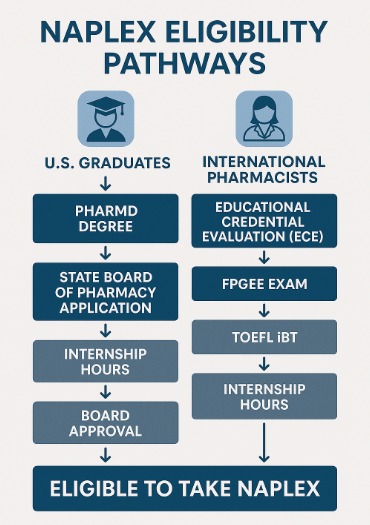
Eligibility for the NAPLEX depends on whether the candidate is a U.S. graduate or an international pharmacist. Understanding the requirements early helps you prepare documentation and plan timelines effectively.
1. Eligibility for U.S. Pharmacy Graduates
Candidates who completed a Doctor of Pharmacy (PharmD) from an ACPE-accredited U.S. pharmacy school must:
- Apply to their State Board of Pharmacy
- Complete the required internship or experiential hours
- Pass a background check (in some states)
- Receive approval from the State Board
- Create an NABP e-Profile and register for the exam
Each state has specific requirements regarding:
- Internship hours
- Timeline of application
- Additional documentation
- Jurisprudence exam (MPJE)
2. Eligibility for International Pharmacists
International pharmacy graduates must first obtain the Foreign Pharmacy Graduate Equivalency Certification (FPGEC) before registering for the NAPLEX.
Requirements for FPGEC Certification
A. Educational Credential Evaluation (ECE)
- Verification of pharmacy degree and transcripts
- Ensures the foreign curriculum meets U.S. standards
- Required before appearing for the FPGEE
B. Foreign Pharmacy Graduate Equivalency Examination (FPGEE)
- Tests fundamental pharmacy knowledge
- Covers biomedical sciences, clinical sciences, and pharmaceutical sciences
C. TOEFL iBT (Language Proficiency Test)
Assesses:
- Reading
- Listening
- Speaking
- Writing
English proficiency is mandatory because patient safety depends heavily on effective communication.
D. Internship Hours
After FPGEC certification, candidates must complete state-specific internship hours, generally between 500 to 1,500 hours.
Once all requirements are fulfilled, the State Board may approve the candidate for the NAPLEX.
3. State-Specific Requirements
Each U.S. state regulates pharmacy licensure independently. Requirements may include:
- Fingerprinting
- Background checks
- Application fees
- Photo identification
- Residency verification
- MPJE (pharmacy law exam)
States like California may require additional documentation and have longer administrative processing times.
NAPLEX Exam Format and Structure
Understanding the exam’s structure is essential for building a strong preparation strategy.
1. Number of Questions and Duration
- 225 total questions (200 questions are scored, and 25 questions are unscored pretest items)
- 6-hour testing time
- No scheduled breaks (you may take an unscheduled break, but the timer continues)
The exam is delivered at Pearson VUE testing centres, offering a secure and standardised environment.
2. Types of Questions
The NAPLEX includes multiple question formats to assess analytical skills and clinical reasoning:
- Multiple-choice
- Select-all-that-apply
- Ordered response (arrange steps in a correct sequence)
- Constructed response (short calculations)
- Hotspot questions (select specific areas on an image)
- Case-based scenarios
Most questions are integrated clinical cases that require interpretation of:
- Patient profiles
- Lab values
- Medication charts
- Clinical guidelines
3. Core Domains Tested in the NAPLEX
Domain 1: Pharmacotherapy and Patient Care (Majority of the Exam)
Assesses your ability to:
- Select appropriate therapies
- Evaluate drug regimens
- Analyse clinical data
- Provide patient education
- Prevent adverse events
Domain 2: Safe and Accurate Preparation of Medications
Includes:
- Compounding
- Medication dispensing
- Error prevention
- Quality control
Domain 3: Medication Safety
Covers:
- Drug interactions
- High-risk medications
- Contraindications
- Black-box warnings
- Reporting adverse drug events
Domain 4: Pharmaceutical Calculations
Includes:
- Dosing
- Conversions
- Compounding formulas
- Infusion rates
- Dilution and concentration
Domain 5: Drug Therapy Management
Focuses on:
- Monitoring patient outcomes
- Adjusting therapy based on response
- Applying clinical guidelines
NAPLEX Exam Fees and Associated Costs
Understanding the financial aspects of the exam helps you plan effectively.
1. Standard NAPLEX Fees
- NAPLEX exam fee: $575
- Retake fee: $275
2. Additional Fees You May Encounter
A. State Board Application Fee
Ranges between $30 and $300, depending on the state.
B. MPJE Fee (Law Exam)
Usually, $150.
C. Score Transfer Fee
- $75 per state (Useful if you want to apply for licensure in multiple states).
D. Scheduling or Rescheduling Fee
Varies based on Pearson VUE guidelines.
E. Additional Costs for International Students
- ECE evaluation fee
- FPGEE fee
- TOEFL fees
- Visa document charges
- Internship training expenses
How to Apply for the NAPLEX: Step-by-Step Guide
Following the correct sequence makes the process smooth and less stressful.
Step 1: Create an NABP e-Profile
- Visit the NABP website
- Enter accurate personal information
- Upload government identification
- Verify identity
Step 2: Apply to Your State Board of Pharmacy
The State Board will confirm whether:
- You have completed the required internship hours
- Your degree is valid
- Your documents are complete
Once approved, you are eligible to register for the NAPLEX.
Step 3: Register for the NAPLEX Through NABP
- Log in to your e-Profile
- Select “NAPLEX”
- Pay the $575 registration fee
Step 4: Receive Your ATT Letter (Authorisation to Test)
The ATT letter will specify:
- Your testing window
- Eligibility dates
- Instructions for scheduling your exam
Step 5: Schedule Your Exam with Pearson VUE
- Choose your preferred testing centre
- Select the exam date and time
- Receive confirmation email
Once scheduled, focus on preparing effectively.
How to Prepare for the NAPLEX (Comprehensive Strategy)
Preparing for the NAPLEX requires planning, consistency, and practical strategies.
1. Recommended Preparation Duration
Most candidates prepare over:
- 2 months (intensive)
- 3–4 months (balanced and effective)
Working professionals may require a longer timeline.
2. Best Study Resources for NAPLEX
The most widely trusted resource. Ideal for clinical topics and calculations.
Offers realistic case-based questions and detailed explanations.
Useful as supplementary material.
⭐ 4. NABP Official Practice Exams
Provides insight into the real exam environment.
⭐ 5. Flashcards and Study Apps (Quizlet, Anki)
Excellent for quick revision of drugs, interactions, and calculations.
3. High-Yield 8-Week Study Plan
Weeks 1–4: Core Clinical Sections
- Infectious diseases
- Cardiology
- Endocrinology
- Gastrointestinal disorders
- Respiratory diseases
- Neurology
- Oncology basics
Weeks 4–6: Applied Practice
- Calculations
- Medication safety
- Immunisations
- High-risk drugs
- Monitoring therapeutic outcomes
Weeks 6–8: Intensive Practice and Mock Exams
- 4–5 full-length mock tests
- Review mistakes in detail
- Strengthen weak areas
- Practice under timed conditions
4. High-Yield Topics to Focus On
These subjects frequently appear on the exam:
- Hypertension and heart failure management
- Diabetes therapy
- Anticoagulation
- Antibiotic selection
- Oncology agents
- Thyroid disorders
- Renal and hepatic dose adjustments
- Vaccination schedules
- Medication error prevention
Mastering these areas significantly boosts your score potential.
5. Importance of Practice Questions
Aim for:
- 2,000 to 3,000 practice questions
- Case-based scenarios
- Time-bound practice tests
Practice helps build:
- Speed
- Accuracy
- Clinical judgement
Must-Know Pharmaceutical Calculations for NAPLEX
Calculations carry substantial weight on the exam. Missing too many can prevent you from passing, even with strong clinical knowledge.
A. Essential Calculation Topics
- Dilution and concentration
- Alligation
- Percentage strength and ratio strength
- mg/mL conversions
- Calculating mEq and mmol
- IV infusion rate calculations
- Creatinine Clearance (CrCl)
- Body Surface Area (BSA)
- Osmolarity and tonicity
- Total Parenteral Nutrition (TPN) formulas
B. Calculation Study Tips
- Practise calculations daily
- Memorise essential formulas
- Avoid unit conversion mistakes
- Recheck your answers carefully
- Use practice exams to test speed
Exam Day Tips and Guidelines
Managing your mindset and strategy is just as important as knowing your content.
1. What to Bring
- Valid government identification
- ATT letter
- Pearson VUE confirmation email
Arrive at least 30 minutes early.
2. During the Exam
- Read questions carefully
- Use the skip-and-return technique
- Manage time effectively
- Stay calm and focused
- Avoid spending too much time on calculations
3. Common Mistakes to Avoid
- Overanalysing simple questions
- Misreading patient case data
- Forgetting unit conversions
- Ignoring drug interactions
- Rushing through time-consuming cases
Understanding the NAPLEX Scoring System
NAPLEX scoring is complex and differs significantly from academic exams.
1. Score Range
- Scores range from 0 to 150
- Passing score: 75
⚠ Important:
A score of 75 does not equal 75%, but represents a scaled score based on the difficulty of questions and overall performance.
2. How the Exam is Scored
- Uses Computer Adaptive Testing (CAT)
- The difficulty of questions adjusts based on performance
- Greater difficulty questions yield higher scoring potential
3. Score Release Timeline
Most candidates receive their score within:
- 2–7 business days
- Some states may take longer
4. If You Fail the Exam
- Must wait 45 days before retaking
- Review your score report
- Identify weak areas
- Modify your study plan accordingly
What Happens After Passing the NAPLEX?
Passing the NAPLEX opens the pathway to becoming a fully licensed pharmacist.
1. Pass the MPJE Exam
Most states require the Multistate Pharmacy Jurisprudence Examination.
2. Complete State Board Requirements
- Background checks
- Internship hour verification
- Submission of additional documentation
3. Obtain Your Pharmacist Licence
Once approved, your licence will be issued and updated in the State Board system.
4. Begin Your Pharmacy Career
After licensure, you can work in:
- Retail pharmacy
- Hospital pharmacy
- Clinical pharmacy
- Long-term care facilities
- Managed care organisations
- Pharmaceutical companies
- Academia
- Research and development
Conclusion
The NAPLEX is a significant stepping stone in your pharmacy career. While the exam can be challenging, thorough preparation, a disciplined study routine, and the right resources can dramatically improve your chances of success.
Whether you are a U.S. PharmD graduate or an international pharmacist aiming to practise in the United States, this detailed guide equips you with everything you need—eligibility information, exam structure, preparation strategies, must-know calculations, and expert success tips.
Stay focused, stay consistent, and believe in your preparation. Your journey to becoming a licensed pharmacist is well within reach.
Best wishes on your NAPLEX journey!
Frequently Asked Questions
1. How many attempts are allowed?
Candidates may attempt the exam up to five times, though state rules vary.
2. How long should I prepare?
Most candidates prepare for 2–4 months.
3. Is the NAPLEX difficult?
The exam is moderately to highly challenging, especially the case-based questions and calculations.
4. Which book is best for preparation?
RxPrep is the most recommended resource.
5. Is the NAPLEX more difficult for international pharmacists?
Yes, mainly due to differences in clinical practice guidelines and language barriers.
6. Should I use score transfer?
Score transfer is useful if you plan to apply for licences in multiple states.