 by
by Lipids are one of the most important biomolecules in our body. They are present in all living cells and have a wide range of roles, including storing energy, forming cell membranes, and even contributing to hormone production. Unlike proteins and carbohydrates, lipids are not soluble in water. Instead, they dissolve in organic solvents like alcohol, ether, and chloroform.
In this post, we will break down lipids into simple, easy-to-understand sections covering:
- What lipids are
- How are they classified
- Their chemical structure
- Their key roles in the body
Whether you’re a pharmacy student, biology learner, or just curious, this guide will help you grasp the topic without complex language.
What Are Lipids? (Definition & Basic Features)
Lipids are naturally occurring hydrophobic organic compounds (water-fearing) or amphipathic (partly water-loving and partly water-fearing) organic compounds. They are made mainly of carbon (C), hydrogen (H), and oxygen (O) atoms. Some lipids may also contain phosphorus, nitrogen, sulphur, and glycol groups.
Key Characteristics of Lipids:
- Hydrophobic nature: Lipids are generally water-repelling due to long hydrocarbon chains.
- High energy content: Lipids provide 9 kcal/g, more than double the energy provided by carbohydrates and proteins.
- Structural role: Lipids form the cell membrane bilayer, which is essential for cell survival.
- Regulatory role: Lipids act as hormones, messengers, and signalling molecules.
- Protective role: Lipids cushion organs, protect nerve fibres, and maintain body temperature.
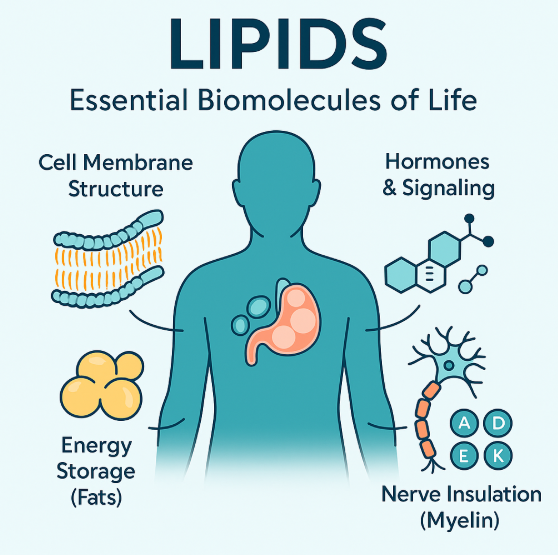
General Functions of Lipids
Lipids perform a variety of essential functions:
- Energy Storage: Triglycerides store large amounts of energy and are particularly useful during fasting, starvation, prolonged exercise, and cold conditions.
- Structural Role: Phospholipids and cholesterol form the structure of cell membranes and provide stability, fluidity, and selective permeability.
- Insulation & Protection: Subcutaneous fat prevents heat loss from the body, while adipose tissue cushions and protects vital organs such as the kidneys and heart.
- Hormone Synthesis: Lipids are required for the synthesis of important steroid hormones such as estrogen, testosterone, and cortisol.
- Nerve Function: The myelin sheath, which is rich in lipids, increases the speed of nerve impulse transmission and ensures efficient communication in the nervous system.
- Vitamin Absorption: Lipids help in the absorption of fat-soluble vitamins A, D, E, and K, allowing the body to utilize these vitamins effectively.
- Signalling Molecules: Lipid-derived molecules such as prostaglandins and leukotrienes regulate physiological processes including inflammation, blood clotting, and blood pressure.
Classification of Lipids
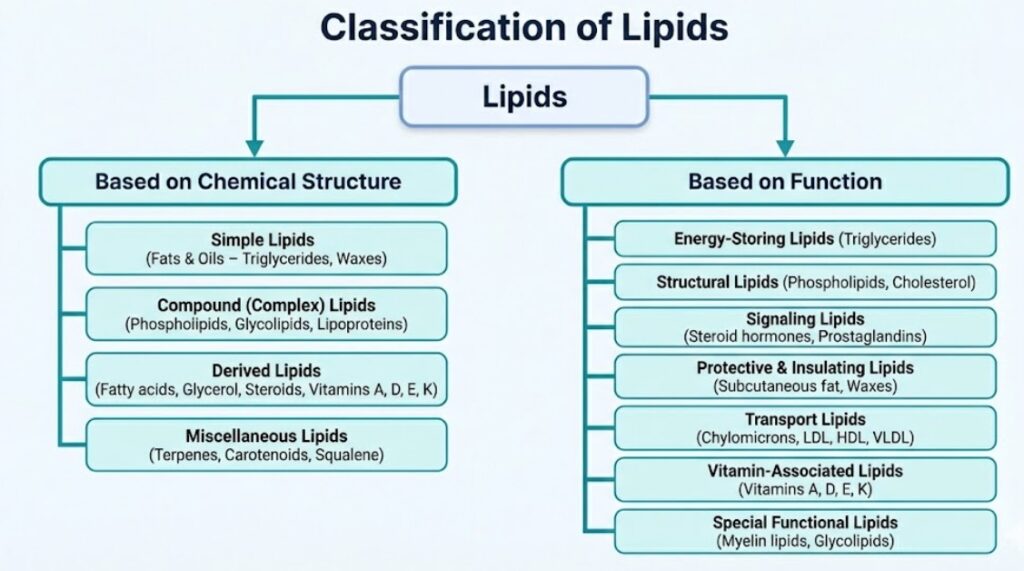
Lipids can be classified in different ways, but the most widely accepted method is based on their chemical composition. According to this system, lipids are divided into four major groups: simple lipids, compound lipids, derived lipids, and miscellaneous lipids.
A. Based on Chemical Composition
1. Simple Lipids
Simple lipids are the esters of fatty acids with various alcohols. They are the most basic form of lipids and serve as major energy stores in the body.
a. Fats and Oils (Triglycerides): Fats and oils are the most common simple lipids and are chemically made of one glycerol molecule attached to three fatty acids, forming triglycerides.
- Fats are solid at room temperature and usually come from animal sources such as butter or ghee.
- Oils are liquid at room temperature and generally come from plant sources such as sunflower oil or olive oil.
Functions:
Fats and oils act as the primary energy reserve of the body and are stored in adipose tissue. They also help in thermal insulation, keeping the body warm, and provide cushioning to protect internal organs.
b. Waxes
Waxes are formed when long-chain fatty acids combine with long-chain alcohols. Their long hydrocarbon chains make them extremely hydrophobic.
Waxes are commonly found as protective coatings on plant leaves, in the cuticle of insects, and as cerumen (ear wax) in humans.
Functions:
Waxes serve as effective waterproofing agents, preventing water loss from plant surfaces, and provide protection and lubrication in animals and humans.
2. Compound (Complex) Lipids
Compound lipids contain not only fatty acids and alcohol but also additional chemical groups such as phosphate, carbohydrates, or proteins. These extra components give them specialized biological functions.
a. Phospholipids: Phospholipids are the most important components of cell membranes. They contain glycerol, two fatty acids, a phosphate group, and a nitrogenous base such as choline or ethanolamine.
Examples:
- Lecithin
- Cephalin
Function:
Phospholipids form the lipid bilayer of cell membranes and help in maintaining membrane structure and fluidity. They also play a role in emulsification, helping fats mix with water during digestion.
b. Glycolipids: Glycolipids are lipids that contain one or more sugar molecules attached to the lipid structure. They are mainly found in the brain and nerve tissues, especially in the outer layer of cell membranes.
Functions:
Glycolipids play a crucial role in cell recognition and signal transmission, which are essential for nerve function and immunity.
c. Lipoproteins: Lipoproteins are complexes of lipids and proteins that help transport insoluble lipids through the bloodstream.
Types:
- HDL (High-Density Lipoprotein) – “Good cholesterol,” removes cholesterol from tissues.
- LDL (Low-Density Lipoprotein) – “Bad cholesterol,” deposits cholesterol in arteries.
- VLDL (Very-Low-Density Lipoprotein) – Transports triglycerides.
- Chylomicrons – Carry dietary fat from the intestine to other tissues.
Function:
Lipoproteins ensure that lipids can move through the blood and reach the tissues where they are needed.
3. Derived Lipids
Derived lipids are produced by hydrolysis or chemical modification of simple or compound lipids. They include important biological molecules involved in metabolism and cell signaling.
Examples:
- Fatty acids (saturated and unsaturated)
- Sterols, especially cholesterol
- Terpenes and terpenoids
- Fat-soluble vitamins A, D, E, and K
These substances are essential for hormone production, membrane stability, and various metabolic processes.
4. Miscellaneous Lipids
Miscellaneous lipids include compounds that have lipid-like properties but do not fit neatly into the other categories.
Examples:
- Carotenoids (pigments found in plants and some animals)
- Squalene (cholesterol precursor)
- Terpenoids (aromatic plant compounds)
- Polyisoprenoid alcohols (components of biological membranes)
These lipids often play roles in pigmentation, antioxidant activity, membrane structure, and biosynthesis of steroid molecules.
B. Based on Function
Lipids can also be classified based on the biological functions they perform in the body. Each functional class of lipid plays a specific and essential role in maintaining normal physiological activities. This type of classification helps students clearly understand why lipids are important, not just how they are structured. Based on their functions, lipids are mainly classified into the following types:
1. Energy-Storing Lipids: Energy-storing lipids are the primary reserve of energy in living organisms. These lipids store excess energy in a compact form and release it when the body needs fuel. The most common energy-storing lipids are triglycerides, which are stored in adipose (fat) tissue.
Functions
- Store long-term energy
- Provide energy during fasting, starvation, and prolonged exercise
- Supply more energy than carbohydrates and proteins
Examples: Triglycerides, fats, oils
2. Structural Lipids
Structural lipids are responsible for forming the basic structure of biological membranes. They are essential for maintaining the shape, integrity, and flexibility of cells. These lipids are major components of the cell membrane, organelle membranes, and nerve membranes.
Functions
- From the lipid bilayer of cell membranes
- Control the movement of substances in and out of cells
- Maintain membrane fluidity and stability
Examples: Phospholipids, glycolipids, cholesterol
3. Signaling Lipids (Regulatory Lipids)
Signaling lipids act as chemical messengers in the body. They help cells communicate with each other and regulate many physiological processes. These lipids are involved in hormone action, inflammation, blood pressure regulation, and cell growth.
Functions
- Act as hormones or hormone precursors
- Regulate cellular communication
- Control inflammation and immune responses
Examples: Steroid hormones (estrogen, testosterone, cortisol), prostaglandins, leukotrienes
4. Protective and Insulating Lipids
Protective lipids provide mechanical protection to vital organs and help maintain body temperature by reducing heat loss. These lipids are mainly stored beneath the skin and around internal organs.
Functions
- Act as shock absorbers for organs like the kidneys and heart.
- Provide thermal insulation
- Protect tissues from physical injury
Examples: Subcutaneous fat, waxes
5. Transport Lipids
Since lipids are insoluble in water, they require special carriers for transportation in the blood. Transport lipids combine with proteins to form lipoproteins, which allow safe and efficient lipid transport.
Functions
- Transport cholesterol and triglycerides in the blood
- Maintain lipid balance in the body
- Deliver lipids to tissues for energy and membrane formation
Examples: Chylomicrons, LDL, HDL, VLDL
6. Storage and Reserve Lipids
These lipids act as energy reserves and are stored for future use. They are especially important during periods of low food intake. Although similar to energy-storing lipids, reserve lipids also serve as a metabolic buffer.
Functions
- Provide energy during emergencies
- Maintain energy balance
- Support metabolism
Examples: Neutral fats stored in adipose tissue
7. Vitamin-Associated Lipids
Some lipids play a crucial role in the absorption, transport, and storage of fat-soluble vitamins. Without lipids, the body cannot properly absorb these essential vitamins.
Functions
- Help absorb vitamins A, D, E, and K
- Support vision, bone health, immunity, and blood clotting
Examples: Fat-soluble vitamins (A, D, E, K)
8. Special Functional Lipids
Certain lipids perform specialized biological roles in specific tissues.
Functions
- Formation of myelin sheath in nerve cells
- Cell recognition and immune response
- Protection against microbial invasion
Examples: Myelin lipids, glycolipids, lipid rafts
Chemical Nature of Lipids
Lipids may look simple, but their chemistry is interesting. Here’s what makes up a lipid:
1. Fatty Acids: These are long chains of carbon and hydrogen with a carboxylic acid (-COOH) group at one end. They are the building blocks of most lipids.
There are two types:
- Saturated fatty acids: No double bonds. Solid at room temperature. (e.g., palmitic acid)
- Unsaturated fatty acids: One or more double bonds. Liquid at room temperature. (e.g., oleic acid)
2. Glycerol: A simple alcohol with three -OH (hydroxyl) groups. It combines with fatty acids to form triglycerides.
3. Phosphate Groups: Found in phospholipids. They make the molecule amphipathic; one part is water-soluble, and the other is not.
4. Other Components
- Sugars (in glycolipids)
- Nitrogen bases like choline or ethanolamine
- Sterol rings (in steroids like cholesterol)
Structure of Some Common Lipids
1. Triglycerides
- Structure: Glycerol + 3 fatty acids
- Function: Energy storage in fat cells
2. Phospholipids
- Structure: Glycerol + 2 fatty acids + 1 phosphate group + nitrogen base
- Function: Structural component of membranes
3. Steroids
- Structure: Four fused carbon rings
- Function: Acts as hormones (testosterone, estrogen), vitamin D, and cholesterol
Biological Roles of Lipids
Lipids are not just fat stored in the body. They perform several life-supporting functions:
1. Energy Storage
- Lipids store more than twice the energy as carbohydrates or proteins.
- Triglycerides are stored in adipose tissue and used when the body needs energy.
- Important during fasting, long exercise, or cold weather.
2. Structural Role in Cell Membranes
- Phospholipids and cholesterol form the lipid bilayer of cell membranes.
- They control what enters or exits the cell.
- Provide fluidity and integrity to cells.
3. Insulation and Protection
- Fat under the skin acts as thermal insulation to prevent heat loss.
- Lipids cushion vital organs like the kidneys and heart.
4. Hormone Production
- Steroids like estrogen, testosterone, and cortisol are made from lipids.
- Lipids also help in hormonal signaling between cells and tissues.
5. Nerve Function (Myelin Sheath)
- Lipids form the myelin sheath that wraps around nerve cells.
- This improves the speed and efficiency of nerve signal transmission.
6. Absorption of Vitamins
- Lipids help absorb fat-soluble vitamins (A, D, E, and K).
- Without enough dietary fat, the body cannot use these vitamins properly.
7. Cellular Signaling
- Lipid molecules like prostaglandins, thromboxanes, and leukotrienes are involved in:
- Inflammation
- Blood pressure control
- Smooth muscle contraction
8. Immune Function
- Some lipids act as barriers against microbes, especially in skin and mucus layers.
- Lipid rafts in cell membranes help in immune cell activation.
Common Sources of Lipids in the Diet
| Food Item | Type of Lipid |
| Butter, ghee | Saturated fat |
| Olive oil, canola oil | Monounsaturated fat |
| Fish oil, flaxseed | Omega-3 fatty acids |
| Eggs, meat | Cholesterol |
| Nuts and seeds | Healthy fats |
Conclusion
Lipids are not just “fat” as commonly misunderstood. They are essential biomolecules with structural, functional, and regulatory roles. From building cell membranes to serving as energy banks, lipids help keep the body running smoothly.
Understanding their types, structure, and biological importance is key for students in biology, pharmacy, and health sciences. Balanced intake of lipids through diet ensures optimal health and disease prevention.
FAQs
1. What are the main types of lipids?
Simple lipids (fats, oils, waxes), complex lipids (phospholipids, glycolipids), derived lipids (fatty acids, steroids), and miscellaneous lipids (carotenoids).
2. What is the function of phospholipids?
They form the structure of cell membranes and help in transport and cell signaling.
3. What are good fats and bad fats?
Good fats: unsaturated fats like omega-3 and omega-6. Bad fats: saturated fats and trans fats.
4. Why are lipids not soluble in water?
Lipids are hydrophobic due to their long nonpolar hydrocarbon chains.
5. Are lipids found in the brain?
Yes, lipids are a major part of the brain, especially in myelin that covers nerve fibers.